
Volunteer archivist Zosia Kuczyńska explores the bookmarks from our Past Shelves exhibition as ‘an archive of attention’.
When we talk about oral histories and the archives and exhibitions that house them, we often do so using the analogy of the ‘snapshot’. It’s a way of thinking that privileges the frozen moment, arresting the motion of history in ways that allow you to notice things that you couldn’t possibly have processed at the time. One of the challenges of staging encounters with archive material is how to navigate this tendency towards temporal arrest. How, to use a phrase I’ve often invoked for myself in relation to literary archives, do we set a legacy in motion rather than in stone? How can we facilitate archival access in a way that keeps in mind one of my favourite no-nonsense definitions of what an archive is – namely, to quote Ann Cvetkovich, ‘a site of practice [. . .] where we do things with objects’?[1]
Something I’ve always appreciated about the Lavender Menace Queer Books Archive, both as a volunteer and as a recovering academic with a special interest in queer archival praxis, is just how well it embodies this idea of a place where we do things with objects. The books it houses are meant to be handled and read; people come in and take things off the shelves; there’s even a reading nook out in the corridor next to the tea-and-biscuits trolley, where there would be no major conniptions had if some hobnob crumbs accidentally got into a duplicate copy of the Armistead Maupin. In fact, I think it would be fair to say that the general atmosphere is often more that of a community library than the kind of archive that houses one-of-a-kind artefacts to be handled only with expert care and a pair of cotton gloves (though we do have those for when a suspiciously sticky donation comes in). It’s a balancing act between conservation and access; between preserving the rare and fragile and allowing people to get their hands on history in a relaxed environment.
Lavender Menace also contains many examples of the kind of object I would like to offer as an alternative to the snapshot when it comes to conceptualising the archive as a site of practice. I am referring here to the bookmark. Whether a printed cardboard calling card from the bookshop in which the book was purchased, a souvenir of a holiday to a queer literature hotspot, or a hastily wedged-in supermarket receipt, the bookmark is an indication that someone’s attention was once parked here. It tells you where someone was, or where they left off, or where they gave up, or where they intended to pick up the thread at some future time that never arrived. It invites you to imagine a reader; to think of a book as someone’s book; to imagine a someone who always shopped in a particular bookshop; to conjure up the kind of scattered optimist who imagines themselves getting round to everything they’ve left half-finished, someday, eventually. Unlike the snapshot, then, the bookmark isn’t a moment that has been arrested and framed, but rather an indicator of the place where someone’s attention once lay – an indicator that also draws the attention of whoever is looking in the present moment. The bookmark invites you to take up the gesture of its being left behind and to engage with something beyond it.
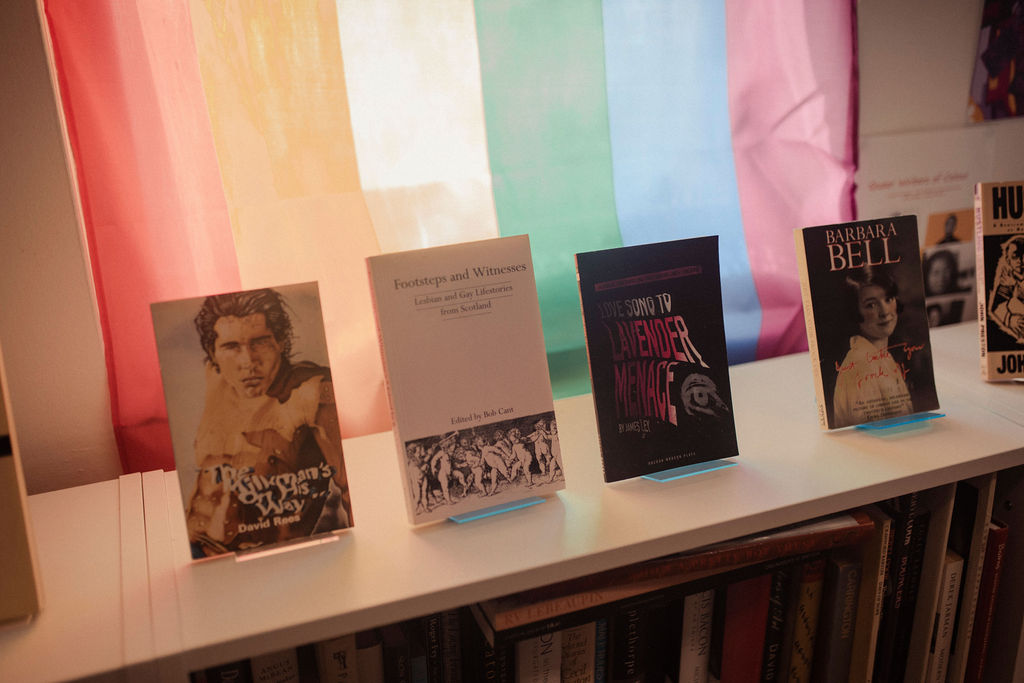
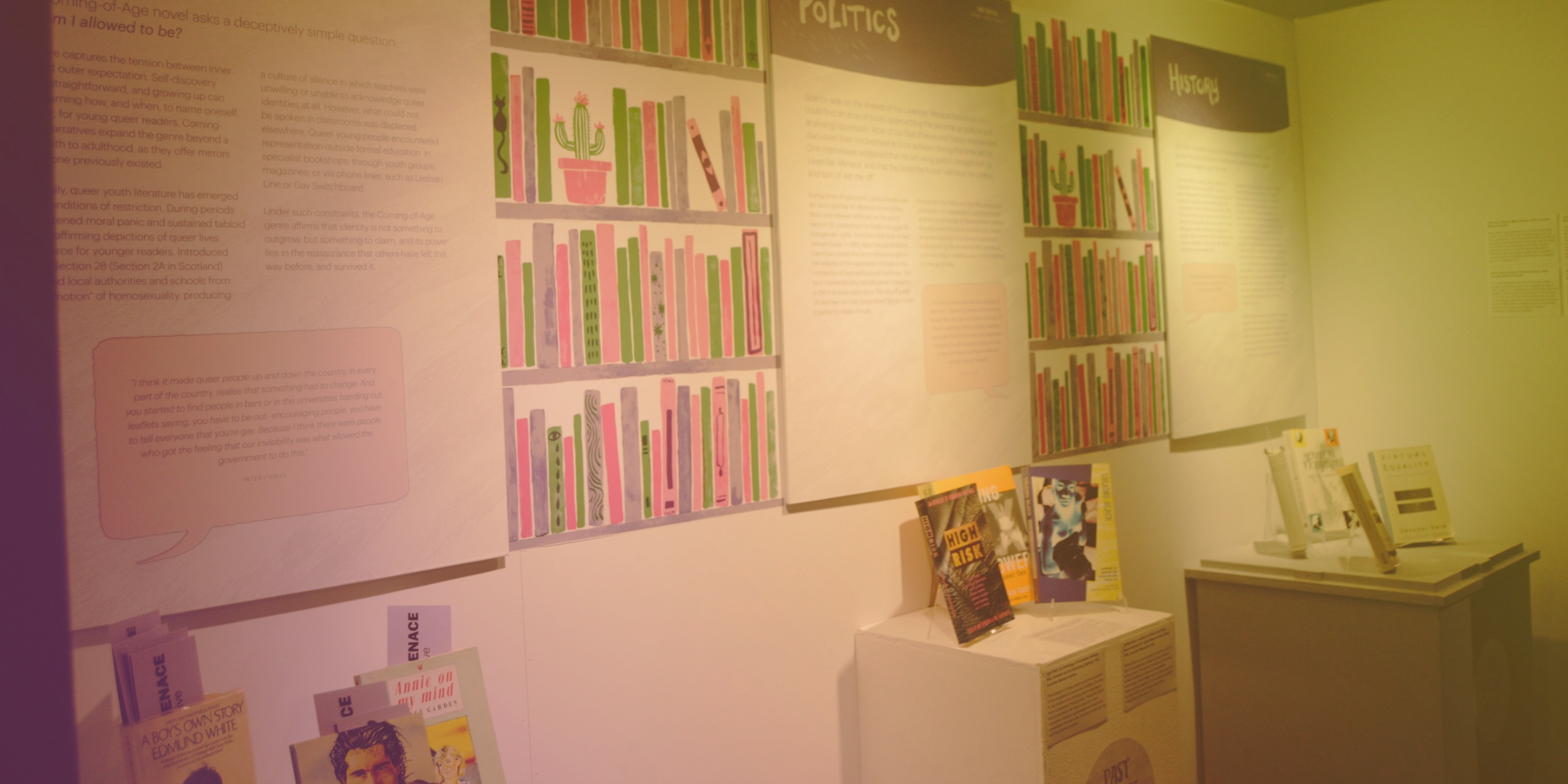
This was a key idea behind the inclusion of bookmarks in our ‘Past Shelves: Histories of Queer Reading’ exhibition at the Museum of Edinburgh, which was built around our oral history project of the same name. We had at our disposal a rich new archive of interview material full of fascinating insights into what people were reading in their formative years and, most importantly, how they felt about encountering (or not encountering) themselves on the page. What we also had was an archive full of books from which to select material to loan to the exhibition – material that didn’t have to be kept behind glass. To give visitors that feeling of encountering a book not as an artefact but as something that once held someone’s attention, we decided to print oral history participants’ reflections on featured books onto replica Lavender Menace bookmarks, which we then placed inside the display copies for people to find.
Absence is as big a part of queer history (or indeed histories of queer reading) as presence. We learn as much from a sense of what was missing as we do from a sense of discovery in what we find. One of the most striking things about selecting oral history interview extracts for the bookmarks was how mixed our participants’ reactions were to the reading ‘essentials’ of the day. For instance, whilst many of our participants shared positive feelings around representation, recognition, and inclusion within genres like the coming-of-age novel, there were also many expressions of frustration with the kinds of stories that were available at the time. A case in point is Edmund White’s coming-of-age novel A Boy’s Own Story (1982), which gave a semi-autobiographical account of growing up as a gay man in the 1950s. Amongst acknowledgements of the importance of ‘seeing yourself in print’ were objections around tone (‘a bit too self-pitying for me’) and relevance (‘[it was ] written really about the generation before mine’) at a time when many young gay men were actively engaged with the assault on the LGBTQ+ community that was Section 28. Meanwhile, for a participant from the trans community, the resonant parts of the book met a stumbling block in the fact that ‘there’s [. . .] so much about him finding fulfilment in being male with other males [and] I can’t celebrate that the way that he can’.
In the context of the exhibition, then, the bookmarks that peppered our display books functioned as what I’m calling (perhaps whimsically) ‘an archive of attention’. Not only does the bookmark itself put us in a headspace where we have to imagine a reader whose attention was focused on a book, but the text on the bookmarks also tells a story of readers who were looking for something. Sometimes they found it; other times, like one reader of The Well of Loneliness who had been hoping in vain for practical lesbian sex tips, they were left wanting. As for me, I began to wonder what it might look like to use this archive of attention to generate a new archive that would give an insight not only into what visitors to the exhibition were reading now, but also into what they were noticing, what they were finding meaningful, and – crucially – what they were still searching for.
It was this that gave rise to the exhibition’s participatory activity, ‘Taking it Off the Shelf’, which encouraged visitors to respond to a series of prompts printed on the back of a set of blank bookmarks with the facsimile Lavender Menace bookmark design. Visitors wrote on the bookmarks and either placed them inside one of the books on display or left them for others to read in the participatory activity area. There were three questions in total:
What was the first LGBTQ+ book that made an impression on you and why?
What book would you recommend to your past or future self?
What story are you still searching for?
The responses were informative, thought-provoking, poignant, and often delightful (including a fair number of unrelated doodles from young children). What was particularly striking was the contrast between the interview responses – which, though full of variety, indicated that there was a kind of essential repertoire that most people had come across – and the exhibition responses, which were hearteningly eclectic. Whilst titles like Heartstopper and Stone Butch Blues came up several times among the first impressions and past/future recommendations, most of the visitor responses were unique, and ranged from They Came to Slay: The Queer Culture of D&D (2022) to a ‘baby tomboy dyke’ appreciation for the works of YA fantasy author Tamora Pierce. (Having been a tween who didn’t know why queer cottagecore mages Lark and Rosethorn were so important to her at the time, I was particularly delighted by this.) The range of coming-of-age stories available was also striking, as was the importance of trans voices coming to the fore in a non-cis-normative way. The way in which younger people related to familiar titles like The Well of Loneliness or Alison Bechdel’s Fun Home was also moving for what it revealed about coming out to family in more recent years: in some examples, these were in fact books that older relatives had recommended as a way of connecting with their queer (grand)kids. Some things, on the other hand, remain endearingly the same: we still turn to speculative fiction to find ourselves, and fanfiction continues to be a staple of contemporary queer culture. (I had to Google ‘Larry Stylinson’ because I’m gradually accepting the fact that I’m solidly middle-aged.)
What, then, are we still looking for? Again, responses vary, but that variety is telling. It seems that as we develop a language for what we’re missing, we become able to articulate the need for a ‘neurodivergent T4T queer platonic story’, ‘working-class asexualism’, or ‘a poly, queer, post-gender [. . .] manifesto for new ways to be’. Some visitors wanted radical imaginings; others wanted uneventful queerness; we still want happy endings; we dream of liberatory futures and gentle retirements.
José Esteban Muñoz famously talked about queerness as ‘always in the horizon’,[2] and as ‘that thing that lets us feel that this world is not enough, that indeed something is missing’.[3] If we keep thinking of archives as places where we do things with objects, or as places where we stage encounters, we can begin to think in doable terms about ‘archives of attention’. What is it in an archive that calls us to notice where it was that people were looking when they were looking at, or for, or even away from that horizon of queer possibility? What is it that holds our attention when we encounter those places where, as with a placeholder left in the pages of a book, we are being invited to pick up where those who came before us left off? And from that place of attention, which queer horizon now holds our gaze?
- Ann Cvetkovich, ‘Foreword’, in Amy L. Stone and Jaime Cantrell (eds.), Out of the Closet, Into the Archives: Researching Sexual Histories (Albany: SUNY Press, 2015), xv–xviii (pp. xvii-xviii).
- José Esteban Muñoz, Cruising Utopia: The Then and There of Queer Futurity (New York and London: New York University Press, 2009), p. 11
- Muñoz, p. 1
