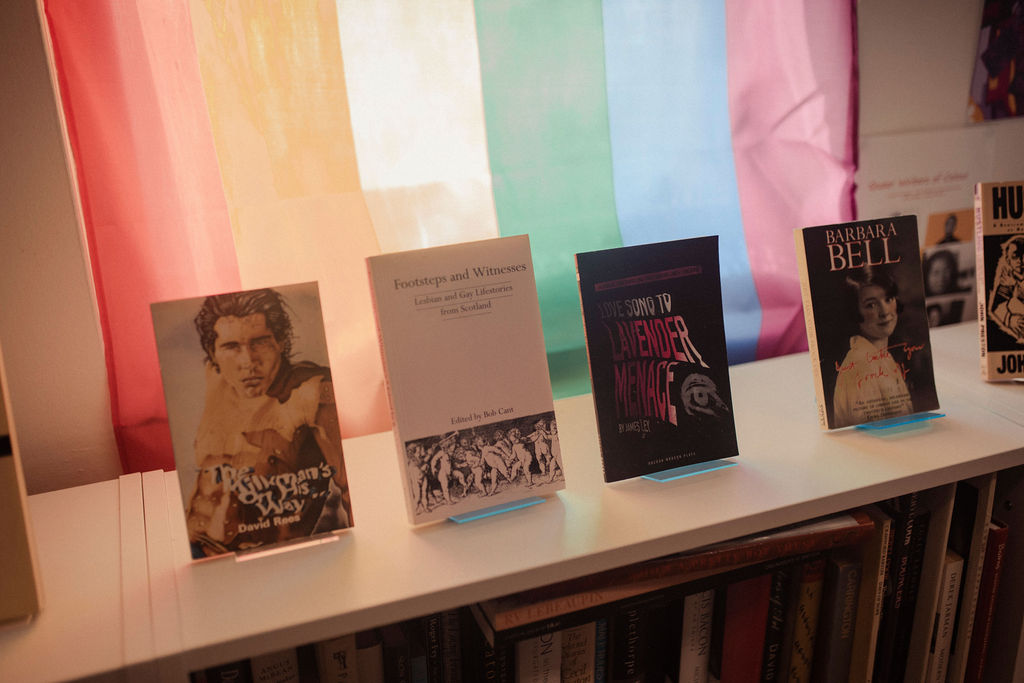

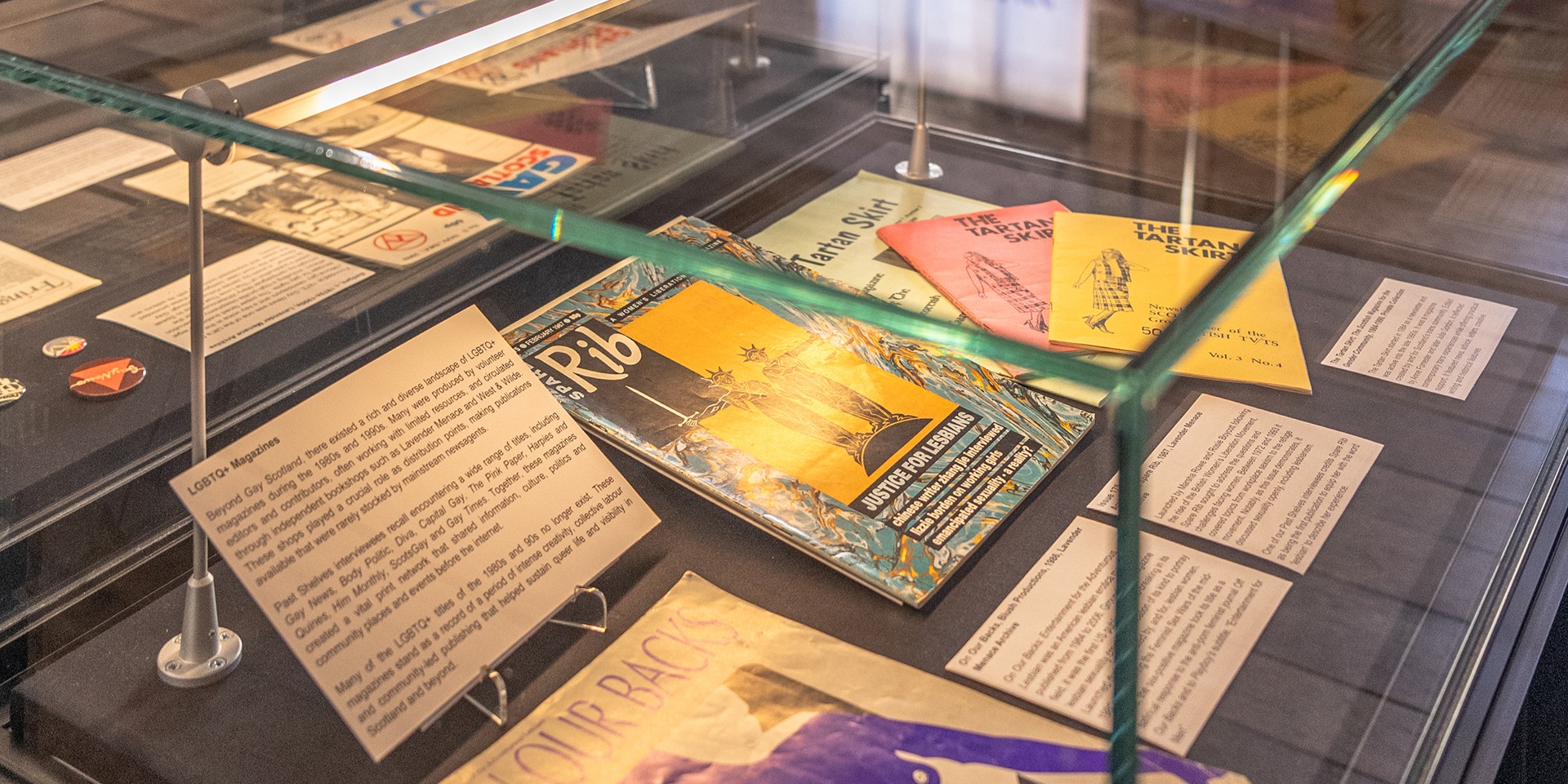
After an incredibly successful run, our co-curated exhibition Past Shelves: Histories of Queer Reading at the Museum of Edinburgh concluded on 20th September 2026. We’d like to take a moment to celebrate the project, and reflect on what we’ve learned.
Past Shelves was inspired by our oral history project, where we interviewed participants with lived experience of the 1980s and 1990s about the role that Lavender Menace and West & Wilde played within Scotland’s LGBTQ+ community.
We are delighted that the exhibition received tens of thousands of visitors, both local and international, those who identify as LGBTQ+ and those who don’t. We received hundreds of comments in our guestbook, and hundreds of book recommendations! This project means so much to us, and we’re genuinely moved to know that it has meant so much to all of you, too. Here is a wee selection of the feedback:
“As a gay trans man, seeing representation such as this exhibit is so needed and so validating, especially now with the government’s transphobia”
“As an Iranian queer woman who didn’t have access to queer history of my country, I am in awe and feeling privileged to be able to learn/know queer histories of countries around the world including Scotland which has become my home!”
“Now more than ever, protecting queer history and literature matters. This exhibition is so important! It is a beacon of hope with European governments turning to the far-right more and more. Every time I’m in Scotland I’m in love with this country. Lots of love from Germany!”
“What a beautiful journey through the queer stories that have shaped us!! Endless gratitude to the queers who campaigned and ran bookshops and gathering spaces that created worlds to thrive in for us – your legacies are precious!”
The majority of the feedback from our tens of thousands of visitors was overwhelmingly positive and we are delighted that the exhibition was well received across the community. However, we were made aware of a formal complaint by a small number of individuals over the summer to the City of Edinburgh Council, who are responsible for the service that operates the Museum of Edinburgh.
The complainants identified themselves as lesbian and took issue with our exhibition’s use of the terms “queer” and “LGBTQ+”. They expressed strong feelings that trans and queer histories should not be grouped with lesbian history. In September, the Council informed us that new signage would be added to the exhibition, explaining the use of queer/LGBTQ+ terminology. We were disappointed that this signage was drafted without consulting us, and therefore did not include our own perspective. Lavender Menace and an independent community member expressed a number of concerns, and as a result the Council made limited changes to remove some of the language we found most harmful. Although we were heartened by these changes and subsequent constructive discussions with the Council, we wanted to take the opportunity following the exhibition to set out our position in relation to the issues raised.
We use the term ‘queer’ in our exhibition. We understand this word has been used as a derogatory term towards LGBTQ+ people, and therefore some LGBTQ+ folks do not use this term. We respect and understand the personal choices that individuals make to describe themselves. We would never ask someone to use a term they find offensive or don’t agree with.
However, Lavender Menace Queer Books Archive embraces the term queer, as we find power in reclaiming terms which have historically been used against us. As far back as the 1980s, West & Wilde sold merchandise bearing the slogan “Queer… You Can’t Beat the Feeling!” (West & Wilde co-founder Raymond Rose shares the story behind the t-shirt here). Before this, the very name of the Lavender Menace bookshop was inspired by a group of lesbians who reclaimed the phrase “Lavender Menace”, which was originally used as an insult against lesbians. This group appear as characters in James Ley’s play Lovesong to Lavender Menace, where they proudly declare: “We are the Lavender Menace, and we are not going away”. For us, reclaiming labels like queer and “lavender menace” is an act of resistance and a way of regaining control over the insults that have been used against us throughout history.
As noted above, we respect that there are people who do not use the word queer, and we respect and understand their choices. However, we also know there are campaign groups who are unhappy with the use of the terms ‘queer’ and ‘LGBTQ+’ to describe our histories, as they do not want trans and queer histories to be included in gay, lesbian, and bisexual histories. We are particularly concerned that this framing is part of a much broader political campaign concerning trans inclusion, the definition of lesbian identity and the boundaries of the LGBTQ+ community.
We are very clear on this – we resist attempts to exclude and marginalise trans and queer people from our shared histories. Transgender customers were welcome at Lavender Menace and West & Wilde bookshops, and the archive today remains firmly trans inclusive. Our lesbian Board members, staff and volunteers reject the idea that we are misrepresenting history or erasing lesbian history. The exhibition was developed collaboratively; we spent three years working on this exhibition with a team of historians, curators, volunteers, and participants who shared their experiences of the 1980s and 90s with us.
We appreciate that many members of the community may have found these developments challenging, as did we. We have therefore been immensely grateful for the support of our community and allies throughout the exhibition. We understand that, in an environment of escalating transphobia and homophobia, institutions which choose to partner with LGBTQ organisations are increasingly exposed to complaints and harassment. We encourage institutions who deliver partnership projects with LGBTQ+ groups to work collaboratively with their project partners when incidents like this occur. Trust is key to any successful partnership project, and it is vital that institutions show trust in their queer collaborators – even when supporting them leads to criticism from others. This should be the case for any collaborations with community groups who work with those most marginalised and excluded from society.
Putting these challenges to one side, we are enormously proud of Past Shelves. Our lasting memories of the project will be about the intergenerational connections between volunteers and interviewees, the joy of discovering some absolute queer gems in the City of Edinburgh Council Collections Centre, and the love that the exhibition has received from visitors.
Thank you to our interviewees, who were so generous with their stories which made us laugh, tear up, and inspired many hours of in-depth research. We are so grateful to you all for trusting us, and we hope the exhibition captured the spark of what you shared with us.
This project would not have been possible without the Lavender Menace Archive volunteers who wrote text for the exhibition, designed resources, and supported the oral history recordings and transcription. Thank you for your time, passion, and dedication – you are all magnificent. And a very big thank you to OurStory Scotland for providing training and for 25 inspirational years of collecting Scottish LGBTQ+ oral histories.
We’ll leave you with a few final comments from our visitors book:
“Love will prevail, we are stronger than those trying to silence and erase us and this exhibit is a beautiful reminder of that x”
“It’s so beautiful to see evidence of the people who worked to make my communities possible. Remember the lost, fight like hell for the living.”
“A sacred place. A reminder to hold each other. My heart is full of dear friends, community, art and stories. It all belongs to us. Thank you x”
We look forward to continuing to celebrate queer heritage by sharing inclusive and diverse LGBTQ+ stories. We are the Lavender Menace, and we are not going away.
