
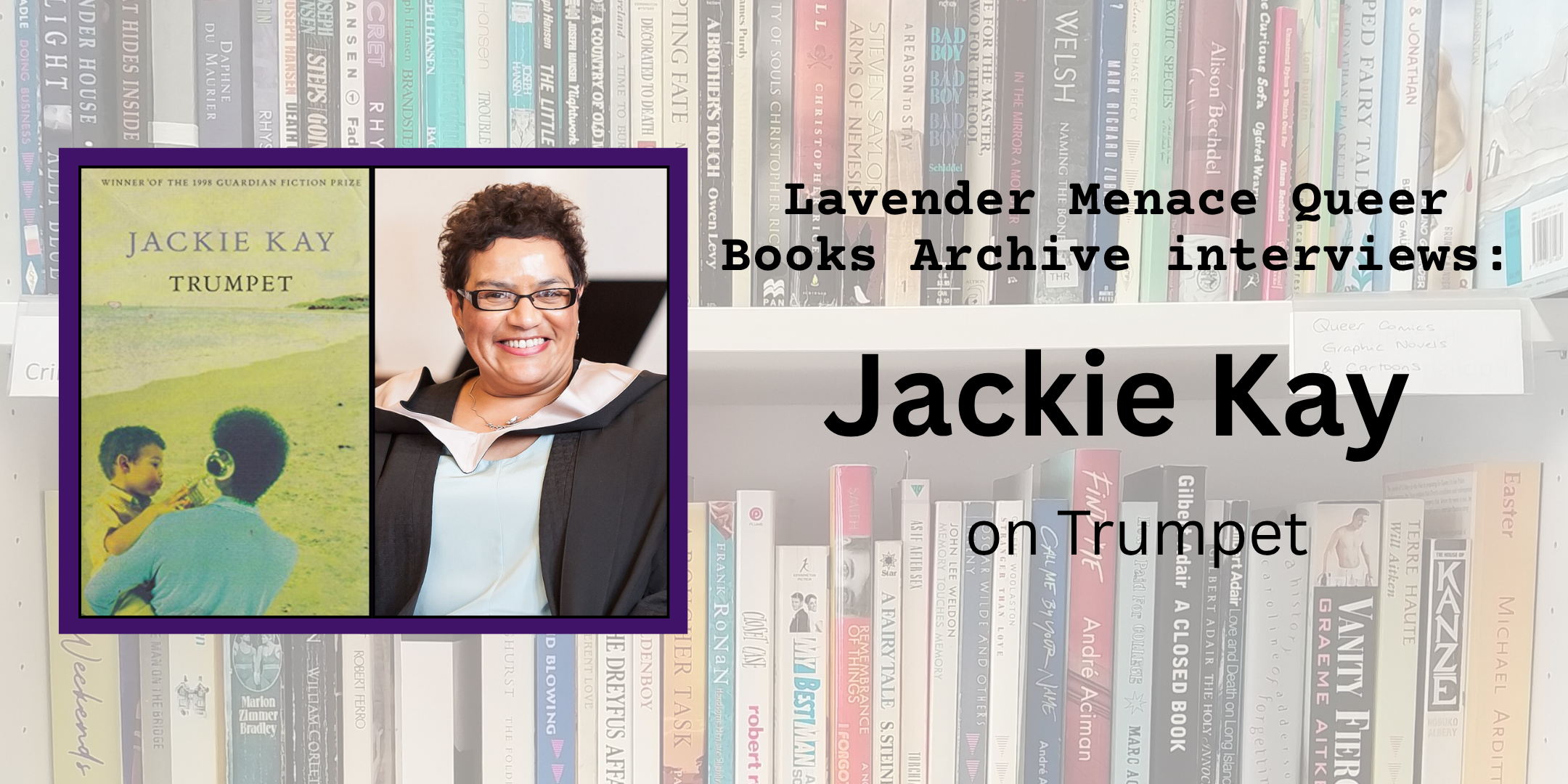
Scottish poet, playwright, and novelist Jackie Kay recently sat down for a conversation with Lavender Menace volunteer Maeve Sheridan to discuss her 1998 novel Trumpet. Following the family of a transgender musician who was outed after his death, the novel navigates media narratives that exploit trans life and the place of grief under those conditions. Trumpet remains popular today as a hallmark of Scottish queer literature.
Note: This conversation was transcribed without the use of generative AI and has been edited for clarity.
MS: By nature of my research, my interest is primarily on the place of mourning in queer literature, especially in trans narratives. Your novel Trumpet, among many other of your works, is centrally concerned with grief. How do you find that mourning affects your politics as well as your literary work?
JK: Grief is one of the things that I write about most, but when I wrote Trumpet, I wasn’t writing it from any personal experience. I hadn’t really had anybody close to me die at that age. So I was writing it from my imagination really, and I found that I was able to imaginatively inhabit what I imagined it would be like for somebody grieving and lots of widows and widowers said to me, ‘how did you do that?’ Because I was only in my 30s when I wrote Trumpet. So, the widow across the road from us said, ‘how did you get inside a widow’s head, Jackie? When you’re so young, how did you do it?’ And I suppose it’s because I think about absence a lot. So I write about absence in one way or another. And in Trumpet, there’s a line about absence being a kind of a presence. And I think that that’s kind of true from my life as an adoptee. Being adopted, you’ve always got this absence, it has been a presence in your life and it means that you’ve already got yourself two lives. So it’s not that much of a leap to think yourself into other spaces, and that’s what writers do anyway. First of all, we imagine. First of all, we imagine.
Absolutely. Funnily enough, I have here in my notes to ask about that line—about how Joss’ presence is defined by his absence. Nearly every account of him we encounter is given at second or even third hand, outside of the chapter ‘Music’ and the final letter. Was there a particular aspect of this framing, for a character like Joss, that drew you to portraying him in this way?
It’s a really interesting question. It’s true that he only appears in these two ways and that was very deliberate in the end. I did try other things. Trumpet took me five years to write, which is ridiculous for a relatively short novel, but I think I’m not a natural novelist and it took me a long time. One of the things that took time was trying to have Joss as a character in it. I just couldn’t get him right. I couldn’t get his voice right, and I found that the best and the most exciting way to deal with not being able to do that, with that failure, was to create him through everybody else. So his presence would be in the heads of everybody else, and we’d hear about him from several different points of view, and we’d only hear about him from his own point of view twice. And I decided that that was very powerful because then it led the reader to think about that and also to be creating their own Joss all the time, to be thinking, what’s Joss thinking of this? Would Joss agree with this? Would Joss think that his son was out of order here? It leads us to ask questions and I think that in anything I do as a writer, I really want my reader to be asking questions along with me. I don’t want to be answering the questions and I never try to. So that is an important question that you’ve just asked: Why is Joss only present for these two moments? And the answer is that it takes a village, you know, if it takes a village to raise a child, it takes one to create Joss. Every single person in the book plays their part in creating Joss, and Joss himself might have had disagreements with some of their portrayals but still they’re adding to a jigsaw picture. When we try to reduce people, we often try and reduce them to this or that, but we’re all multiple. I really believe in the idea of multiple identities, I really believe in multiplicity, and I think we live in far too simplistic a society now where people want this or that, and everything’s polarized. And so I think the reason that Trumpet is still a popular book all these years later is because it deals with some of these questions of multiple identity.
That is something that I find really interesting in the novel, we inhabit these disparate characters, like the doctor and the registrar. Specifically those two, it’s people that encounter this grief, and Joss as a person only through these bureaucratic structures built around death. What brought you to decide on going deep into the mind of these characters that would otherwise be a passing detail in the narrative?
I’m really interested in how people that do pass through our lives can have a massive impact in our lives, like doctors, undertakers, or registrars. We might only meet them for a moment, but they can vividly stay with you. So the registrar in the book is based on a registrar that I met when I went to register the birth of my son. He was a very beautiful man. He took his time. He had a lovely pen. And although I don’t imagine that he had the experience that the registrar has in Trumpet, there was something about his taking his time with each person that impressed me. And whenever I’m with any doctors, I’m kind of struck by how much they get to know about your life, about your intimacies, about your particulars, about your stats even, and how much that tells them about you. So I really wanted to create Joss through all of these people, through veritable strangers, really. He never met the registrar, he never met the doctor, but they all still have a way of looking at him and his story, so they were important. And because we are so obsessed about the medical side of transitioning, and we are more obsessed with it now than we were then, It’s kind of interesting now that you have a doctor with that point of view, so I’m kind of quite pleased that the doctors in there and that there’s nobody being, you know, crassly judgmental in the book apart from the journalist.
How do you think of Trumpet as, if you would say that it is, a trans novel, and how it is relevant today with the situation in the United Kingdom. What place does it have, and how has that evolved?
I don’t myself categorise Trumpet in any particular way, except for a novel that has reached out and touched the lives of lots of different people in different ways. I think it’s very prescient about trans issues because it’s prescient in its use of pronouns. It’s prescient in its idea that we should be able to define our own identities and we shouldn’t have to justify that. And if people love us, they should join us in the way that we see ourselves and that there is an element of fluidity about our own identities. And that’s what I was really interested in when I was writing about Trumpet, is that male and female are presented to us as fixed states, black and white are presented as fixed states, all sorts of other things, but there’s a lot of fluidity. And so I took jazz as a metaphor because jazz has moved from work song to blues to jazz and has gone on now to, hip hop, et cetera. If you just look at the whole history of black music, you see all of these transitions and fluidity. So I took music as my central metaphor for what happens with gender and with sexuality. I think that is definitely a trans issue and the way that trans people are treated or have been treated and are still being treated is shocking and appalling to me. And as a feminist, I feel very sad about other feminists that seem to find trans people a threat. I find it shocking and I find how polarized and toxic and how much venom there is really, really upsetting. I didn’t go through all I did to have this. I didn’t come out at 16, I didn’t go on gay pride marches, I didn’t learn to be open, I didn’t speak out in order to have this. It’s sad. And so if Trumpet is a novel that some trans people feel supported by, I’m pleased. Though, I have met some trans people that don’t like it and find it objectionable—I don’t think it’s a novel universally loved by trans people.
Yes, yeah it is a bit divided, I’ve definitely encountered that. So, you said that the structure of it is very influenced by jazz music. Would you want to talk a little bit more about that? Do you think that there is any connection or emphasis that comes from portraying queerness through jazz? Is jazz queer?
I’ve never been asked that before, that’s fantastic. I really love it. Jazz is queer. Jazz has always been queer. If you go back to the blues women, and I wrote a book about Bessie Smith that I wrote at the same time as Trumpet. I was stuck writing Trumpet, I had different problems, I couldn’t work out. So I stopped writing Trumpet altogether and wrote this book about Bessie Smith. And then when I came back to it, after writing about the blues women and immersing myself in jazz and blues for a whole year and a half, I unlocked something in Trumpet. I realised that the solution to my problem was music. It was the music. It was a musical structure that I needed. So you have the main voices, Colman and Millie, as the main body of the narrative and then you have all these other pieces, these voices coming in and out like solos in a jazz concert. You have the registrar, Big Red McCall, the cleaner, and they’re all like solos in a jazz concert. To me, the solution is always in structure for everything that I write, but often I don’t find that solution until I’m three quarters of the way through something. I like to set myself on a journey. I’m not one of these writers that plans a structure in advance because if I’m not surprised, my readers are never going to be surprised. So I’ve got to have an element, but that means that it’s a brown-knuckle ride. But to answer your question more specifically, I think that jazz and blues and the great blues heroines have always embraced a double identity. Bessie Smith herself was bisexual, probably more likely lesbian than bisexual, but she couldn’t properly come out at the time. She sometimes dressed in men’s suits, sometimes dressed in kind of diva plumes and in these extraordinary photographs. Her identity was very multiple and so as there’s been a lot of jazz people right the way through and loved by queer people. You know, if you go into, say, the Harlem of the 1920s, when the great artists and the writers and the blues performers were all there, they were all befriended by lots and lots of gay people and some of them were gay themselves. So the idea that queer people are not black, which kind of was around in the 70s, I can never quite understand because black queer people have been around for a very long time. So black queer people that are jazz musicians have been around for a long time. So yeah, I think jazz is queer in the sense that it’s innovative, it’s doing something different, it’s sticking its neck out, it’s daring, it’s being prepared to always change the goalposts and always be fluid. Always welcome the new, constantly be welcoming the new. That’s one thing that queer people have as well. We’re always having to adapt, having to change, depending on circumstance. One minute we’re illegal, next minute we’re legal, one minute we can’t get married, next minute we can get married. You know, one minute we can walk peacefully in the street for pride, the next minute we’re being attacked and driven into, such as the recent horror in Berlin. So no queer person ever takes for granted that being queer is a safe state, and nor do musicians ever take for granted that there’s safety in it. There’s a lot of jeopardy in being a jazz musician, especially in the Deep South in America, where singers like Ella Fitzgerald had to go in the back door.
Do you think strides have been made to reconcile the lack of visibility for people of color in the queer community? You say that the idea of being both black and queer wasn’t really around in the 1970s. How pervasive is this idea still, and how has it improved since then?
I think it’s massively improved in some parts of the world. I think it depends where we’re talking about. Certainly in this country, it’s improved. In Scotland, it’s improved tenfold. Scotland is statistically supposed to be one of the most gay friendly countries to live in in the whole of Europe. And that wasn’t the case when I was growing up. I left Scotland because it was so unfriendly to be a lesbian at 16. So I left and came and went down to London where I knew lots of lesbians, particularly lots of black lesbians. And I joined a group called the BLG, the Black Lesbian Group, and there were 50 of us, which seemed amazing. We were all completely amazed to find each other because we all thought we were the only one. Attitudes have changed a lot and people know that a lot of black people, particularly because of a lot of black gay people being visible and being out there and being outspoken. I think that makes a big difference. It means that younger black gay people have somebody that they can see, and I think that makes all the difference. I think the tide has changed so that that kind of rank homophobia is really looked down upon because culturally there are so many gay people that are making things.
So, with Trumpet being a novel set primarily in Scotland, how would you say that this interaction and tension between your Scottish identity and your queerness came through in the work?
Trumpet is a very Scottish novel, as well as being a very queer novel, as well as being a very black novel. And I really wanted to have a novel that kind of, you know, rather than people kind of always asking you to choose between Is it more important to you being black or is it more important to you being Scottish? Is it more important to you being a lesbian? And people would always ask these questions and I get really bored of them because it’s the arithmetic of oppression. And then they’d ask you which side of you felt the most oppressed, and I just get bored with it. So Trumpet is a novel that embraces all aspects of my personality, black, queer, Scottish and working class. Joss is working class, and is from a working class background. He’s very much brought up in a working-class home and his mother, that we come to at the end of the book, is very much a wee Scottish working-class woman in a sheltered house. So I was just really interested in writing about class, music, sexuality, race, Scottishness, all in the one book. And I think it’s fairly unique in that way, Trumpet. I don’t think there’s been another book that has done that in that way and certainly not with race involved too. So it felt good for me that it was there, that it’s out there. I feel very Scottish, I’m quintessentially Scottish, but I also feel very black. So it’s, you know, yeah, it’s good to find a way or a form or a voice to write in. Which is always a struggle because if you’re not brought up with a dialect, you’re not brought up with a patois or Nigerian expressions or another language that you can go to, and you’ve been brought up in a white culture, as I was, then it’s quite difficult to find a way to vividly create black people just because of voice, because of ear. I like to get people’s voices exactly right and without patronizing them or being cringeworthy. So that’s always been a kind of lifetime struggle for me, how to also be black on the page. Trumpet did that for me because I was able to create Joss Moody, and he was liberating for me. If I was to run into him in the street, I would say, ‘thanks, buddy’ and shake his hand. That’s how real my characters are to me. I wouldn’t be surprised if I ran into Joss Moody in the street. For ages after finishing Trumpet, I really missed them. I missed all of them. It was kind of terrible. It might be the reason I’ve not written another novel, because that was a kind of grief. I know that sounds a bit over the top, but it is a kind of loss that you have after you’ve finished writing a novel. You lose your characters and you wonder what they’ve been thinking and what they’ve been making of this.
